

01 / Card payment service: from an on-premises data centre to the cloud
Diebold Nixdorf runs a service for its customers that issues and accepts cards in closed-loop card schemes, such as employee-benefit cards. The service covers the whole card lifecycle: accounts, limits, top-ups, blocking and inputs for card production. On the acceptance side it processes transactions from POS terminals, a mobile wallet and online top-up.
For Diebold Nixdorf we designed and are carrying out the move of this service from its own PCI environment to the cloud. The migration builds on our long-term development of the application, so it starts from detailed knowledge of its components and operational dependencies.
The challenge: change the platform, keep payments secure
The migration covers application changes, a move from Oracle to PostgreSQL and the use of managed cloud services. The design accounts for PCI DSS requirements and limiting downtime during the transition.
How the solution works
The target solution uses containers on Azure Kubernetes Service and managed services for messaging, files and e-mail. Our work covers application changes, integration and preparation of the operating environment.
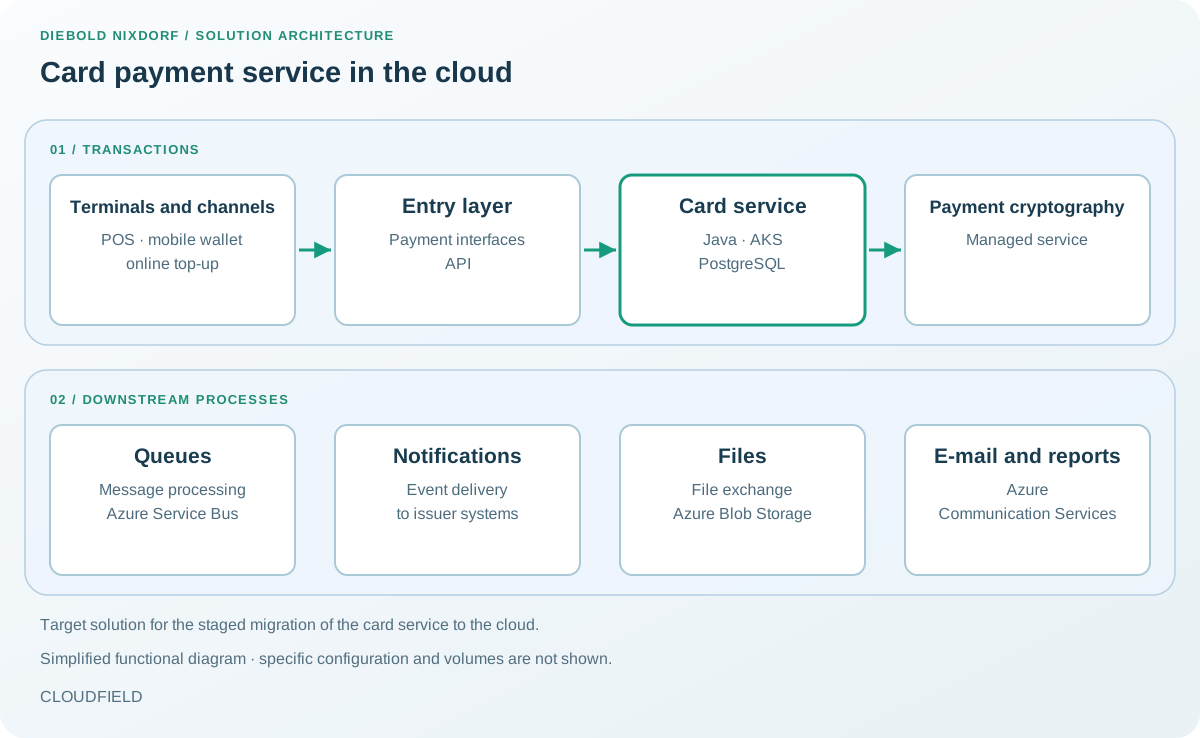
Simplified functional diagram. It does not show network topology, specific configuration or transaction volumes.
We validated managed payment cryptography in a proof of concept and then integrated it into the application.
We are preparing the database transition in stages, with data validation and a procedure for returning to the previous state.
Technologies and our role
| Area | Technologies | What we deliver |
|---|---|---|
| Application platform | Java, Spring Boot, Azure Kubernetes Service | Changes to the application and its components for running in the cloud |
| Data | Oracle → PostgreSQL | Design and execution of a staged migration |
| Integration | Azure Service Bus, Blob Storage, Communication Services | Replacement of queues, file transfers and e-mail |
| Cryptography | Managed payment cryptography | Proof of concept and integration |
| Infrastructure | Azure, infrastructure as code | Isolated environments, network connections and monitoring |
What the migration delivers
Diebold Nixdorf replaces its own hardware and licences with managed services and simplifies the operation of an environment that has to meet strict payment standards. Isolated environments and infrastructure as code make further development and onboarding of additional customers easier.
02 / EET 2.0: from checkout to sales registration
For Diebold Nixdorf, we develop the client and server components of an EET 2.0 solution and prepare their operation in Azure. This builds on our work on the original Czech electronic sales registration system, where we handled installations, certificates and client application changes.
How the solution works
On the merchant side, an agent written in Go receives data from the checkout system through both the existing and the new interface. If the connection drops, the agent stores the records and sends them once it is restored. The agent talks to a fiscal server that passes the data on for registration. A simulator mode lets merchants verify their checkout integration without live submission.
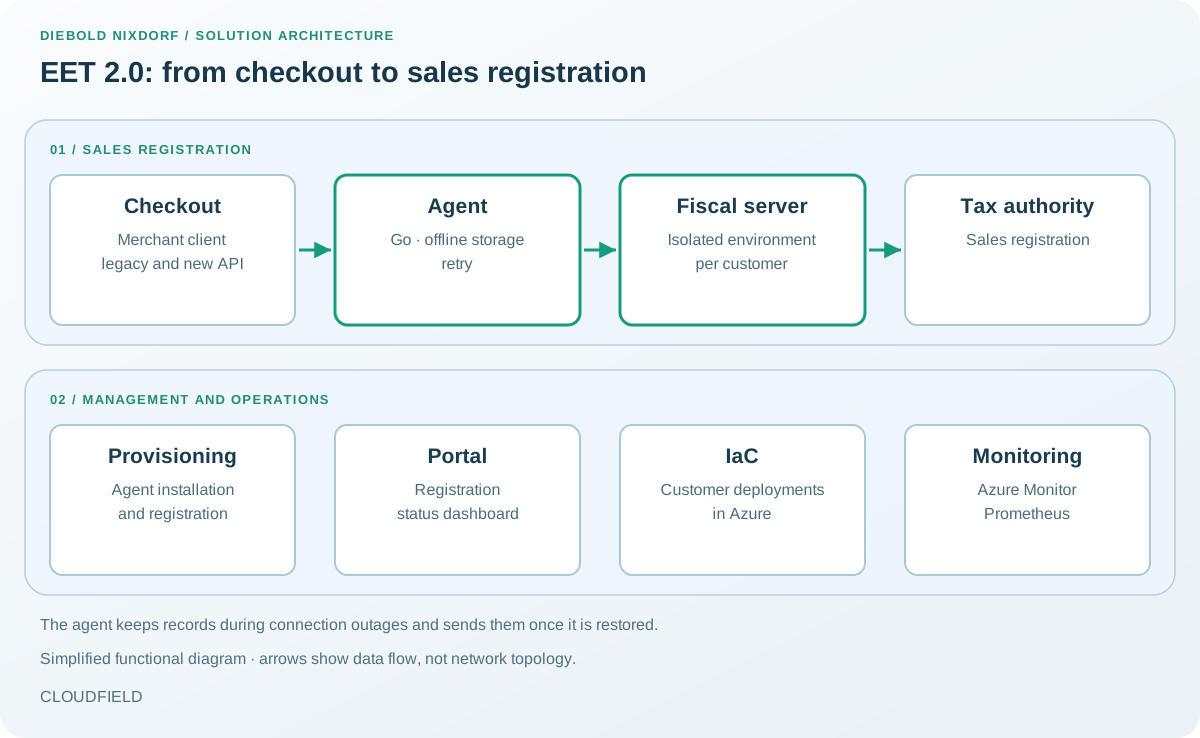
Simplified functional diagram. Arrows show data flow, not network topology.
Each customer has its own isolated environment, deployed through infrastructure as code. Provisioning handles installation and registration of agents, including older checkout stations. A portal shows registration status, and operations are monitored with Azure Monitor and Prometheus. The fiscal server has been load tested and verified against the tax authority’s test environment.
Technologies and our role
| Area | Technologies | What we deliver |
|---|---|---|
| Client | Go, offline storage | Checkout agent, retry, simulator mode |
| Server | Fiscal server, database | Design, development and load testing |
| Management | Provisioning, portal | Agent registration and a registration-status dashboard |
| Operations | Azure, IaC, Azure Monitor, Prometheus | Isolated customer environments, deployment and monitoring |
What EET 2.0 delivers
We are preparing the solution to connect checkout systems to sales registration, including support for connection outages. Delivery includes documentation, installation procedures and automated deployment.
03 / Vouchers and closed-loop card schemes
Since 2020 we have developed systems for Diebold Nixdorf that retail customers use every day.
- Online vouchers. Voucher validation and redemption at the tills of retail chains in several countries, including batch processing, secure file exchanges with partners and single sign-on.
- Electronic vouchers and campaigns. Management of e-vouchers, voucher cards, QR codes, automatic promotions and budgets, plus reports for merchants.
- Card schemes and mobile payments. Top-up through a payment gateway, card tokenisation, an Android mobile wallet, Apple Pay, HSM integration and device identity management.
- Checkout and attendant applications. An Android application for self-checkout attendants and interfaces for communicating with checkout lanes.
04 / Long-term development and support
Payment and voucher systems must stay secure years after their first release. Ongoing care for the applications is therefore part of the collaboration:
- framework and runtime upgrades (Spring, Java, application servers) and remediation of security vulnerabilities,
- a software bill of materials (SBOM) and fast response to critical library flaws,
- change analysis, estimates and documentation for Diebold Nixdorf customers,
- regular operational support, incident resolution and testing of new releases.
What the collaboration delivers
The long-term collaboration covers retail application development, cloud migration and operational support. Our knowledge of the existing systems helps us plan changes around their operations and dependencies.
“Together with Cloudfield, we develop retail solutions for our customers over the long term. We jointly design and implement systems for payment transactions, closed-loop card schemes and EET data consolidation. All systems are designed with a focus on efficient operation across our data centres (PCI environment) and Microsoft Azure.”
— Kryštof Tůma, Business Development Manager, Diebold Nixdorf