Software development is changing faster than ever before. We don’t just bring tools — we deliver a complete transformation program that takes your team from assisted development to fully agentic workflows. With measurable results from month one.
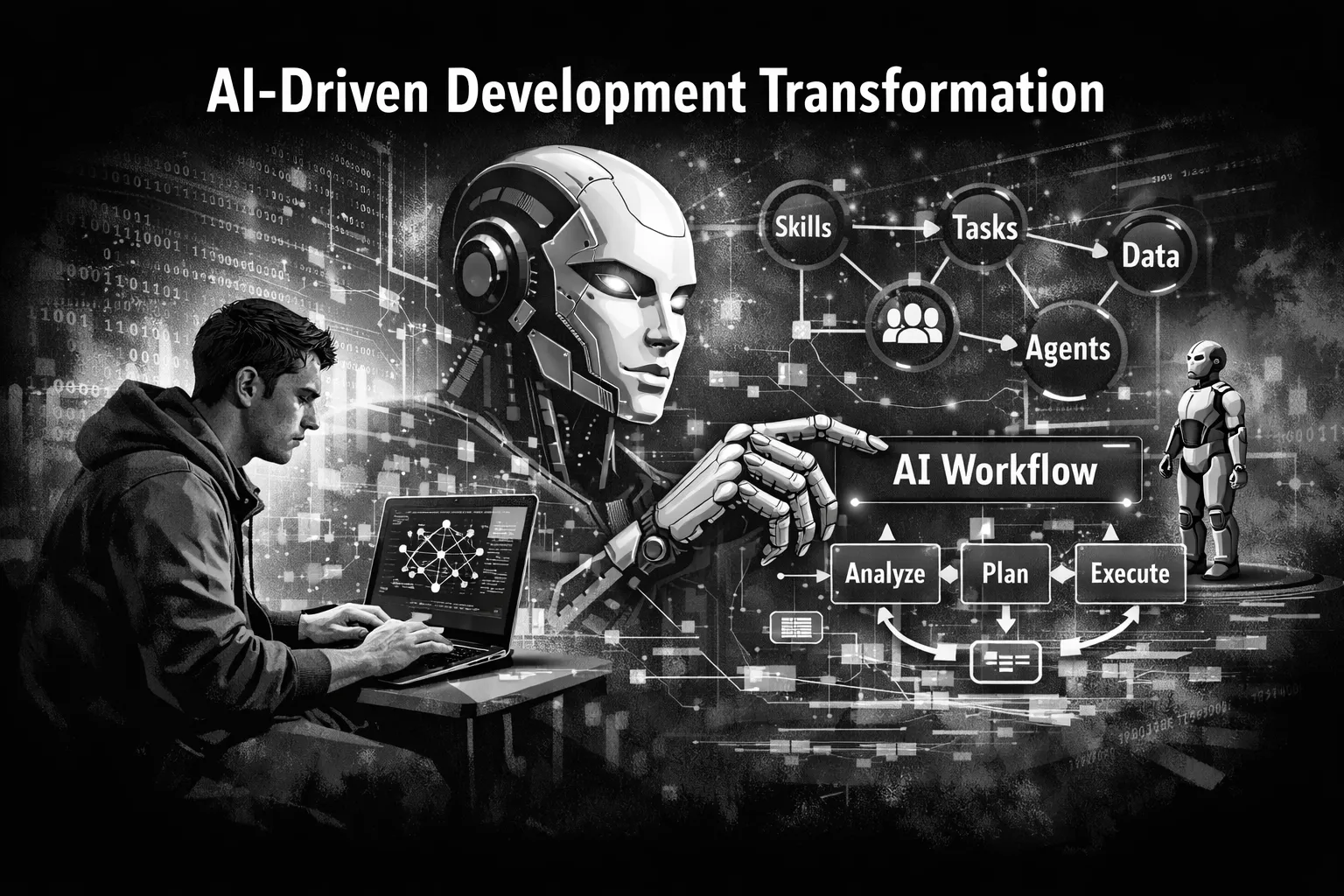
Why Now: The Window of Opportunity Is Closing
72% of developers worldwide already use AI tools daily. 42% of committed code comes from AI assistants. Gartner predicts that by the end of 2026, 40% of enterprise applications will contain AI agents. And Dario Amodei, CEO of Anthropic, stated at Davos in January 2026 that “we are 6–12 months away from AI doing most of the work of software engineers.”
This isn’t science fiction. It’s a reality that most companies with in-house development are just beginning to prepare for. At Cloudfield, we’re already living it — 100% adoption of GitHub Copilot, 90% of the team on Claude Code — not just developers, but project managers preparing specs and marketing generating technical content. AI isn’t just a dev tool for us; it’s a company-wide working tool. Add to that our own AI infrastructure built on models from Anthropic, OpenAI, and Google. And now we’re offering that experience to you.
What Does “AI Development Transformation” Actually Mean?
Most companies today are stuck in the first phase: they purchased GitHub Copilot licenses, developers liked it, management checked the “AI adoption” box. But Copilot-style assistance — completing code line by line — is just the beginning. It delivers 30–50% speedup but doesn’t fundamentally change the way you work.
The real transformation happens when you move to agentic development. Tools like Anthropic’s Claude Code don’t work line by line. They receive an entire task — “refactor this component,” “write tests for the whole module,” “design the architecture for a new service” — and process it autonomously. The developer shifts from being a code writer to an architect and reviewer. In practice, our sprint velocity grows 2–3× compared to baseline — measured on comparable task types with the same definition of “done.” It’s not a magic number; it’s the result of a different way of working.
Copilot isn’t standing still either — its latest versions already offer elements of autonomous work, and agentic capabilities are rapidly evolving. The boundary between the two worlds is shifting. We’ll help you navigate this spectrum and find the optimal mix for your team, your architecture, and your processes.
Superpowers: An AI Agent with Your Company’s DNA
This is the key differentiator that sets us apart from generic “AI consulting” offerings. And honestly — it’s the thing that determines whether your AI transformation actually works or ends up as another disappointment.
A generic AI agent — whether Copilot, Claude Code, or anything else — is powerful but blind. It doesn’t know how your company names services. It doesn’t know your coding standards. It has no idea what your microservices architecture looks like, what your deployment pipeline is, what your internal security policies are, or how you structure code reviews.
Superpowers are structured knowledge sets — skills — that give the AI agent your organization’s context. A set of instructions, best practices, company conventions, and process rules that are “loaded” as the agent’s expertise. The result? The agent doesn’t work generically — it reflects your company’s real environment, as if it had been working there for years.
What this means in practice:
- The agent follows your naming conventions and coding standards
- It respects the architecture and design patterns of your codebase
- It generates code consistent with your existing code base
- It adheres to your security policies and compliance requirements
- It knows the structure of your CI/CD pipeline and testing framework
- It understands your domain terminology and business logic
We’ve seen it many times: without Superpowers, a team tries the AI agent and abandons it after a week — because the output doesn’t match company standards and rewriting takes more time than writing from scratch. With Superpowers, adoption is natural and results are immediate. This is the difference between “we have AI” and “AI actually works for us.”
We design and fine-tune Superpowers together with your team. It’s not a one-time configuration — it’s a living artifact that evolves alongside your product. And this is where our experience shows — at Cloudfield, we first tailored and battle-tested Superpowers on our own projects. We know what works and what doesn’t.
Metrics: No Buzzwords, Just Hard Data
AI transformation without measurement is just an expensive experiment. That’s why we developed a framework of four metric categories that we track on every project. It’s not an academic exercise — it comes from what we learned during our own transformation.
1. Productivity Sprint velocity, lead time, cycle time, deployment frequency, throughput. We measure how much work a team actually delivers per unit of time — and how that changes with AI deployment.
2. Code Quality Code coverage, code smells, cyclomatic complexity, security hotspots, bug rate. AI accelerates development, but if quality drops at the same time, it’s a Pyrrhic victory. We track both.
3. AI-Specific Metrics AI suggestion acceptance rate, team-wide adoption rate, actual time saved, usage of agentic workflows vs. traditional assisted development, Superpowers effectiveness. These metrics show whether the team is truly using AI — or just has it installed.
4. Developer Experience Developer satisfaction (NPS), new team member onboarding time, quality of auto-generated documentation, code review time. Because the best tool is worthless if the team rejects it.
Key principle: we always measure the baseline. Before introducing any AI tool, we establish the starting point. Then we track progress at 30, 60, and 90 days. We report results in a format that both the CTO and CFO can understand — not abstract charts, but concrete impacts:
- Code review time: −50% thanks to AI pre-review
- Bug detection: +40% thanks to AI security scanning
- Sprint velocity: 2–3× baseline with full agentic adoption
- New developer onboarding: significantly shorter thanks to AI-generated documentation and Superpowers as “corporate memory”
This includes an ROI model and regular management reporting. We want you to have numbers you can use to justify the investment to the board — not just a feeling that “AI is probably helping.”
What the Transformation Looks Like in Practice: A 4-Phase Program
We don’t do one-off workshops that lead nowhere. Our AI Dev Transformation Program is a structured annual program with four phases. This is how we do it for our enterprise clients — and how we did it for ourselves.
Phase 1 – Discovery & Kickoff A full-day workshop for the development team and engineering management. We map the current state: what tools you use, what your processes look like, where the bottlenecks are. We set baseline metrics. We run an internal hackathon where the team tries agentic tools on real tasks. We define a tailored AI adoption strategy.
Output: AI Maturity Score, prioritized list of use cases with ROI estimates, 12-month AI Roadmap.
Phase 2 – Architecture & Pilot We design an AI governance framework — rules for who can do what, how AI-generated code review works, how logging and auditing are handled. We launch a pilot deployment of selected tools on a real project. We implement MCP (Model Context Protocol) — an open standard that enables AI agents to communicate with your systems (JIRA, Git, CI/CD, monitoring) through a unified interface. In practice, this means the agent isn’t isolated in the IDE but can see and influence your entire development ecosystem. We begin building Superpowers for your codebase.
Output: Functional AI gateway, first Superpowers set, governance documentation, pilot results with metrics.
Phase 3 – Code Intelligence & Expansion We extend AI to understand the entire codebase — the agent doesn’t just write new code but understands the context of existing code. We connect AI to company documentation (Confluence, Notion, internal wiki) via a RAG pipeline. And yes, we know what that looks like in practice — 80% of corporate wikis are outdated. That’s why we start with content curation and help AI distinguish current documentation from fossils. The result is often a side benefit in itself — a finally cleaned-up knowledge base. We expand the MCP ecosystem with additional integrations — JIRA, GitLab, monitoring, CI/CD. Superpowers are refined based on team feedback.
Output: AI that knows your entire codebase and documentation. Measurable results at 90 days vs. baseline.
Phase 4 – Automation & Optimization We introduce automated AI code review — every pull request goes through AI review before human review. We deploy AI security scanning for continuous vulnerability detection. We implement dependency graph analysis for proactive technical debt management. We prepare AI-powered onboarding for new team members.
Output: Fully AI-augmented development pipeline. Final ROI report. Recommendations for the next year.
We tailor the program scope to each situation — team size, process maturity, and ambitions. Not every client needs all four phases at full scale. But it always represents a fraction of the annual development budget with the potential to fundamentally change productivity and output quality.
And what if adoption doesn’t go according to plan? It happens — not every team embraces a new way of working overnight. That’s why we measure continuously and iterate on the program. If after Phase 1 we see the team needs more time on the basics, we don’t rush into Phase 2 at all costs. We’d rather slow down and do it right.
Technology Stack: Multi-Model, Vendor-Agnostic, Security-First
We don’t bet on a single vendor. Our AI stack combines the best of available platforms — and this approach ensures you never end up with vendor lock-in:
- GitHub Copilot Enterprise – code completion, pair programming, growing agentic capabilities. Ideal as a first-stage adoption and daily working tool.
- Claude Code (Anthropic) – fully agentic development, complex reasoning, refactoring, architectural tasks. Rated by us as the most effective for demanding tasks.
- Cursor IDE – AI-native development environment for teams that want an integrated experience.
- Google Jules – agentic assistant from Google for autonomous task resolution directly in GitHub workflows. Strong in multi-step planning and integration with the Google ecosystem.
- JetBrains AI Assistant & Junie – AI directly in IntelliJ, WebStorm, and other JetBrains IDEs. Junie adds agentic capabilities for more complex tasks. A natural choice for teams accustomed to the JetBrains ecosystem.
- MCP (Model Context Protocol) – an open standard for AI agent communication with external systems. The future of interoperability and something we’re betting heavily on.
- Custom AI Infrastructure – internal tools built on a combination of models from Anthropic, OpenAI, Google, and others.
Everything runs with maximum emphasis on security and intellectual property protection. Models run on dedicated instances, your data is not used for training and remains under your control. For regulated sectors (finance, healthcare, government), we offer on-premise and private cloud options.
AI Security: comma0 as Your Security Shield
AI transformation introduces new categories of risk that traditional security frameworks don’t account for. Our subsidiary comma0 specializes in this and provides the complete security dimension:
- AI Code Security Audit – systematic review of AI-generated code, detection of patterns that human reviewers easily miss
- LLM Application Security – protection against prompt injection, data leakage, model manipulation, and other LLM-specific threats
- AI Governance Framework – policies, processes, responsibilities, audit trail for AI-augmented development
- EU AI Act Compliance – gap analysis, AI system classification by risk categories, remediation, ongoing compliance monitoring
- AI SOC Monitoring – continuous anomaly detection in AI-generated code and AI system behavior in production
This is something many companies underestimate. AI accelerates development, but if you don’t have the security of AI-generated code covered, you’re creating a new kind of technical debt. The combination of Cloudfield + comma0 = performance and security under one roof.
Who Is AI Dev Transformation For
Our program is designed for companies that:
- Have their own in-house software development (10+ developers)
- Already use or plan to deploy AI tools but want more than just “Copilot for everyone”
- Need measurable results and ROI, not just a cool demo
- Operate in regulated environments and need governance and compliance
- Want AI to reflect their processes, architecture, and standards — not generic best practices
Typically, we’re approached by CTOs or VPs of Engineering at companies that feel “things could be better with AI” but don’t know where to start — or have started but are stuck at the first level of adoption. Sound familiar? We’ve been there too — and that’s why we know the way forward.
How to Get Started
| Service | What You Get | Typical Scope |
|---|---|---|
| AI Readiness Assessment | Audit of current state, AI Maturity Score, roadmap | 1–2 days |
| AI Tool Selection Workshop | Hands-on comparison of tools on your code | 1 day |
| Hands-on AI Training | Developer training on agentic tools | 1–2 days per group |
| AI Implementation Pilot | Real project with metrics, first Superpowers | 4–6 weeks |
| Full Transformation Program | Complete 4-phase program with ongoing coaching | ~150 person-days/year |
| AI Security Audit (comma0) | Security review of AI deployment, compliance check | 1–2 weeks |
Each service works standalone or as part of the whole. We recommend starting with the AI Readiness Assessment — in two days, you’ll know where you are, where you can get to, and what it will take. With concrete numbers, not a PowerPoint full of buzzwords.
Why Cloudfield
We’re not consultants who read about AI in reports. We’re a company that went through AI transformation ourselves — and now we’re passing on what works. 90% of our team on agentic tools, our own multi-model AI infrastructure, real enterprise projects from logistics to finance to government.