
Helping with text while officers retain responsibility
Criminal casework requires officers to work with textual material. Language models can help with this work, but their use must respect the sensitivity of the police environment and the responsibility of the people reviewing their output.
For the Police of the Czech Republic, we develop AIDA, an AI assistant supporting officers who handle criminal cases. The system is in production, with rollout to additional workplaces under way. Our engagement covers analysis, design, implementation, deployment, technical support and further development.
A custom system within the police environment
AIDA is built for the internal environment of the Czech Police. The solution includes integration with an internal records management service. The Police receive the source code, providing a basis for maintaining and developing the system over time.
The architectural framework includes the application, language models and Kubernetes within police infrastructure. It separates production, testing, development and training environments. These support different stages of the solution’s lifecycle, from preparing changes to everyday use and training.
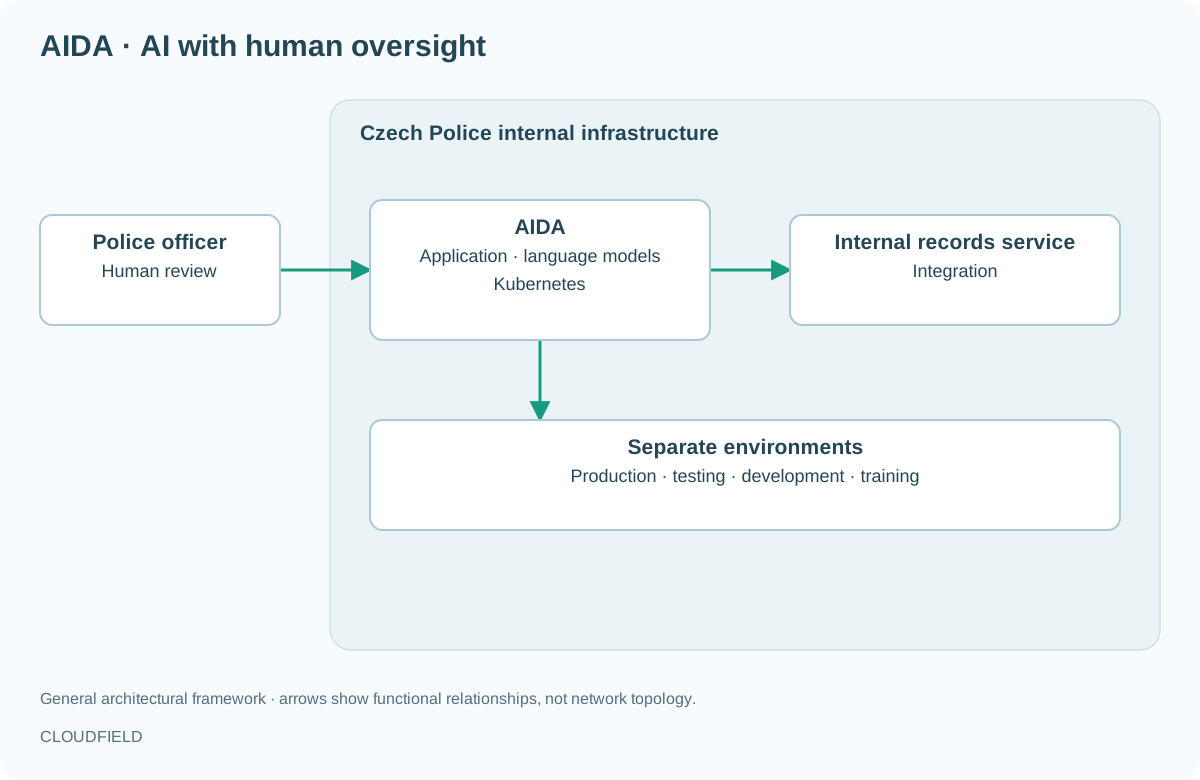
The diagram shows the general architectural framework and functional relationships. It does not describe network topology, specific models or integration implementation details.
Security starts during development
Working with police material requires clear boundaries between operations and development. Contractual rules require the supplier to use test data rather than real case files. Internal deployment and separate environments form part of the framework for building and developing the solution.
Delivery requirements cover cybersecurity, personal data protection and compliance with the AI Act. They include risk management, a fundamental rights impact assessment and documentation.
AI assists; people decide
A language model’s output is material for human assessment. AI use in police work must preserve human review and responsibility for decisions. The assistant supports case officers in their work without taking over their authority.
Production use and gradual rollout
AIDA is in production. Rollout is extending access to additional workplaces. Deployment is supported by technical and operational assistance, a helpdesk, consulting and development services.
The ongoing engagement allows the system to evolve after its initial deployment.
Technologies and our role
| Area | Technology or framework | Our contribution |
|---|---|---|
| AI | Language models, contractual LLM/RAG framework | Assistant design and development for the police environment |
| Application environment | Internal infrastructure, Kubernetes | System implementation and deployment |
| Integration | Internal records management service | Connecting the assistant to the internal environment |
| Lifecycle | Production, testing, development and training environments | Separating operations, change validation, development and training |
| Support | Helpdesk, consulting and development services | Technical and operational support and further development |
What the engagement provides
The Police gain an AI assistant adapted to their environment, with source code and ongoing support. Its purpose is to help officers work with textual material while preserving human control over its use.