

A service response starts with the right part
LINET manufactures healthcare beds for customers around the world. A service request may appear simple: a customer needs a replacement part and its price. The operator must identify the bed, find its assembly and select the appropriate component. Information can come from several generations of business systems.
For LINET, we developed an AI assistant that connects internal data from Salesforce and business systems and retrieves information from internal product documentation. For service cases, it prepares a draft response using available evidence and presents it to the operator for review directly in Salesforce.
How the solution fits together
Salesforce passes the incoming message to an application in Azure. The application analyses the question, retrieves supporting data and returns a draft response with a link to the processing details. The integration is asynchronous: accepting the request and delivering the result are separate steps.
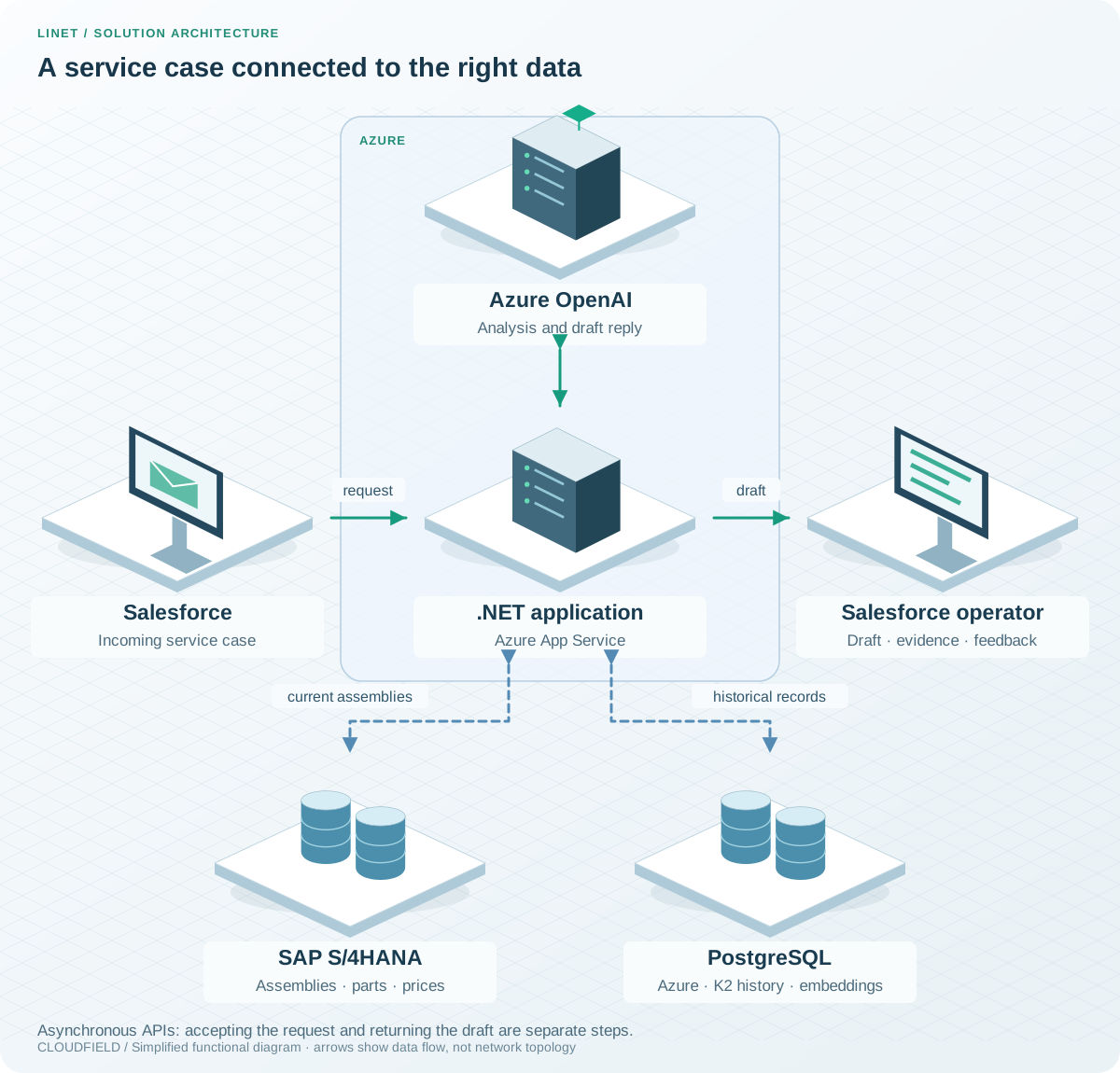
Service assistant architecture based on the project specification. The diagram shows functional relationships. Product team support and wider business system integration are additional areas of the partnership.
From a customer message to a component lookup
The assistant first analyses the incoming message and checks whether it contains the identifiers needed for a search. For spare parts, this may mean the bed serial number, model or part number. A missing identifier matters: the operator should know that the request is incomplete before a response is based on an assumed product.
The next step searches the bill of materials: the tree of components used to assemble a bed. A serial number identifies the actual assembly of a particular bed; a model number supports a model-level assembly lookup. Available data includes part descriptions, identifiers and prices.
For a replacement handset request, for example, the assistant searches for matching components and their available details, then drafts a reply. If a price or another required item cannot be found, it flags the incomplete result.
The operator can inspect the supporting evidence
The draft returns to the corresponding Salesforce case. A detail page shows search parameters and retrieved records used to compose the response. The operator can check the part selection and its relevance to the customer’s question.
A feedback mechanism lets operators rate the usefulness of a draft and describe missing or incorrect information. This helps guide further development using actual service cases. Sending the response to the customer remains part of the operator’s work.
Current and historical data in one workflow
The technical specification connects a .NET application on Azure App Service to the SAP S/4HANA bill-of-materials service. Historical K2 assemblies are supplied as exports and stored in PostgreSQL. Azure OpenAI supports query analysis, semantic retrieval and response composition.
This connection to source data makes the assistant useful in practice. The language model uses tools to retrieve the concrete information required for the service case.
Supporting product teams and sales
Another part of the partnership brings together manuals, measurement reports and certificates for product specialists. Full-text and semantic search locate relevant passages even when questions use different terminology. Responses link to source files and support technical enquiries, tenders and marketing preparation.
We also connected CRM, ERP and billing modules across the quotation-to-invoice process. Consolidated data reduces manual re-entry between systems and supports continuity between commercial steps.
Technologies and our role
| Area | Technologies | What we address |
|---|---|---|
| Service cases | Salesforce, asynchronous APIs | Request delivery and draft responses |
| Application logic | .NET, Azure App Service, Azure OpenAI | Query analysis, tool use and response composition |
| Assemblies and history | SAP S/4HANA, K2 exports, PostgreSQL | Part searches across current and historical data |
| Result review | Processing details and feedback | Traceability of supporting records |
What the partnership delivers
Service operators receive drafts in their existing workspace and can verify the data used. Product teams can retrieve supporting documentation, while commercial processes draw on consolidated information. AI assistance connects to people’s daily work and the business systems behind it.
“By working with Cloudfield, we significantly improved the efficiency of customer service and internal business processes. The solution using AI assistants unified data, shortened response times and reduced administrative workload across the organisation.”
— Miroslav Lapour, Information Technology Director, Linet spol. s r.o.